
The Fremont County Multi-Day Arrest Archive
One source stands above the rest. The Fremont County Sheriff’s Press Release archive publishes public arrest news in dated groups that span several days or a whole reporting period, reaching back at least to 2024. Entries reach into 2026 as well.
A live roster drops people once they bond out. The archive does not. An arrest can stay on the page after a person posts bond, finishes time, or moves to another agency's custody. It also adds lifecycle facts. Look for initial appearance, bond, release date, release reason, or a dated statement that someone is still in custody. Each release is a snapshot from its own date, so treat the status lines as a moment in time.
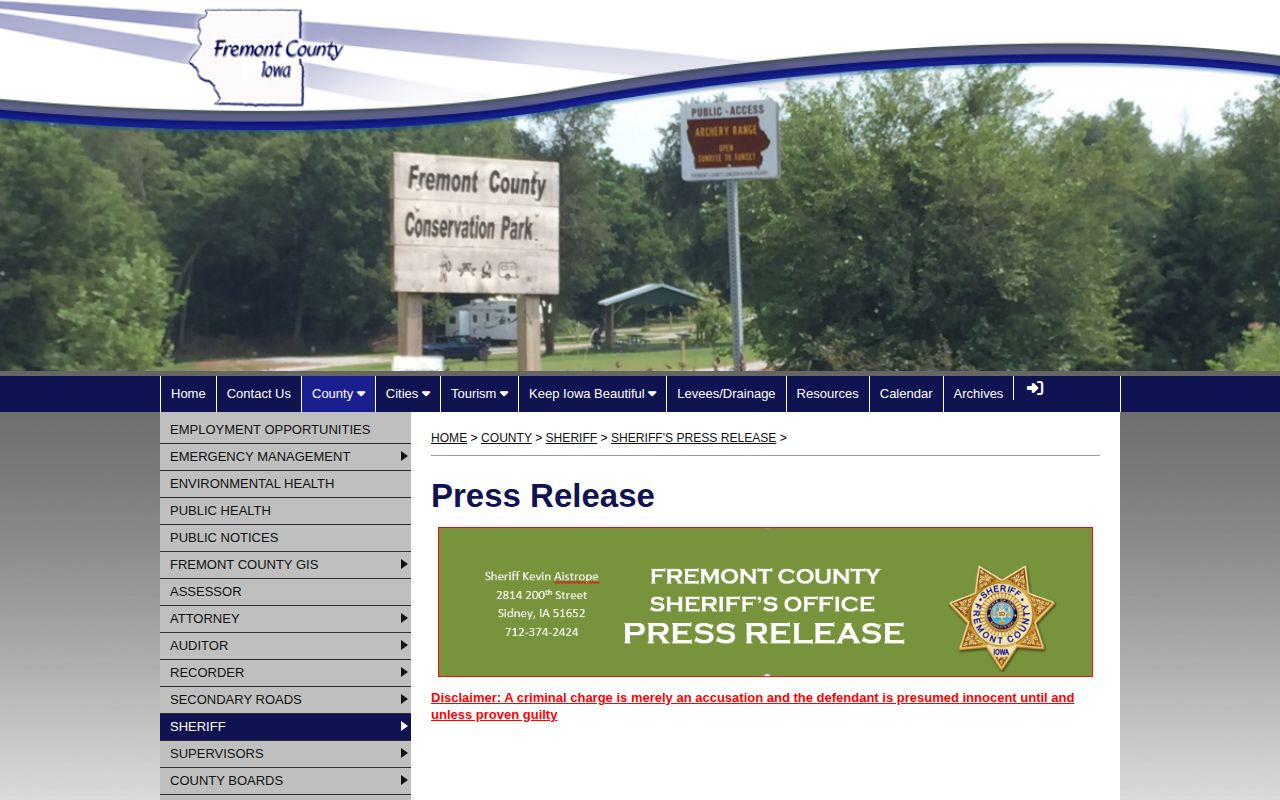
The view is good for tracing published events, yet it still falls short of a guaranteed rolling seven-day roster.
How to Read Fremont County Sheriff Releases
Start at the date headings. Work down to each event's details, and never assume the page date, arrest date, booking date, and release date share a single day.
- Open the official archive. Begin with the newest dated group and note the reporting range in its heading.
- Find the person carefully. Compare the full name with age, town, address, arrest location, or event date when those details are stated.
- Separate event dates. Record the arrest date and time apart from a later initial appearance, bond, transfer, or release.
- Keep the charge wording. Treat the stated charge and Iowa Code citation as an charge reported by the Sheriff.
- Move through older pages. Preserve each dated source instead of combining repeated names or distinct events into one profile.
- Verify later status. Call the jail for custody or use Iowa Courts Online for a public disposition when the question goes beyond the release.
An event may be too new for a batch release. Turn to the Daily Arrest Report. Its official same-day fallback covers what a batch has not posted yet. The weekly archive stays better for date-range review and later status notes. The Fremont County recent-arrests hub keeps the archive separate. Jail, court, DOC, and federal records sit in their own lanes there.
Fields in a Fremont County Arrest Release
Field depth varies from release to release. One item may carry full detail while another skips the time, booking ID, photo, or release status, so write "not stated" rather than guessing into an empty field.
| Possible field | How to interpret it |
|---|---|
| Full name, age, city or address | Identity information as printed in that release. |
| Arrest location, date, and time | The reported event details, which may differ from the publication date. |
| Charge and Iowa Code citation | The Sheriff’s charge wording, subject to later court action. |
| Initial appearance | An early court-process event, not the final disposition. |
| Bond type and amount | Terms stated at that moment, which may later change. |
| Release date and reason | Release from that custody event, not dismissal of the case. |
| Still in custody or transfer | A dated status statement that requires current verification. |
| Inline image | A selected official release image; the Sheriff states no complete-photo policy. |
No stable booking ID appears here. The archive also lacks a sortable live status, a site-wide "last updated" time, or any documented roll-off policy. One small photo on an item does not mean every booking gets pictured online.
Weekend Arrest Dates and Batch Posting
Weekend arrests often travel in packs. One later release can carry several weekend dates. The archive holds July 2026 examples. Separate arrests and their later releases carried distinct dates across those entries. That lag is why a multi-day view catches events a single calendar-day check might miss. No posting rule is published. There is no weekend, holiday, cutoff, or catch-up schedule either. Monday timing is not guaranteed, nor is any set number of hours. For a weekend date that matters, scan the next dated group. Then confirm with the jail or the record custodian.
An empty weekend group can mean several things. Nothing may have been picked for publication, an item may be delayed, another agency may hold the record, or the details may not be public. Do not summarize it as "no arrests."
Fremont County Archive Depth and Retention
The press stream runs back to 2024. How deep it truly goes is another matter. The county promises nothing about how many pages stay online, when an item rolls off, or how long the underlying record is kept. Web availability and legal retention are separate questions. Iowa public-record guidance does not create an archive retention schedule. When an arrest falls beyond the visible depth, request the record directly from the Fremont County Sheriff’s Office. Give a specific person and a date range. The office sits at 2814 200th Street, P.O. Box 359, Sidney, IA 51652-0359. The published number is 712-374-2424. Ask for the custodian and a fee estimate, since the county posts no request form, fee table, response promise, or retention schedule.
Note: An online press release is a publication record, not a complete statement of every record the Sheriff may retain.
Regional News Arrest Reports Are Secondary
KJAN prints episodic Fremont County arrest reports. One item spans July 29 through August 12, 2024. That helps for context. It is not a current jail roster. The KJAN archive shows how a regional outlet can preserve a dated report outside the county's own pages, though the Sheriff source should always outrank it.
Remember that KJAN is a secondary copy. Check names, dates, charges, release details, and any corrections against the Sheriff or the court. Local papers are another layer. None carries a dedicated current arrest page. The titles include the Hamburg Reporter, the Sidney Argus-Herald, and the Fremont-Mills Beacon-Enterprise, though a print or paywalled story there would not prove a live blotter.
Why the Weekly Log Is Not a Crime Trend
A weekly arrest log is a sample, not a census. It cannot prove crime rose or fell. Publication choices, delayed reports, and cross-county handoffs all shape which arrests reach the page. Some bookings never appear at all. Counting visible names is not counting offenses across Fremont County. Repeated names call for the same care. Two entries may be separate arrests, or an arrest paired with a later release update. They can also sit months apart. So keep every source date intact. Never merge entries into one record, and never read a pattern from a single name. For statewide trends, use an official statistical series. Defined coverage and method make it the right yardstick. For a named event, the Sheriff release comes first. The later Fremont County court docket stays the reliable trail from there.
Agency Handoffs in the Fremont County Log
Jurisdiction matters when an arrest crosses a line. The Fremont County Sheriff covers most of the county. Tabor switched its provider to Mills County Sheriff service on August 1, 2026, under a short-term agreement. So a Tabor entry hinges on its arrest date. Check which agency the source actually names. A release to another authority is not a release to the community, either. Preserve the exact wording. Then look for the receiving agency before choosing which custody system to check. If the destination is silent, mark it “not stated.” Charge seriousness is not evidence of a federal transfer or a state-prison placement. That agency-first reading is why the multi-day archive earns its keep. It holds context a bare name list would lose. Facts still change after publication, so confirm current custody with the facility or the court. Whenever you save or cite an entry, keep the arrest date, the named agency, and any stated receiving authority together.